How Room Thermostats Turned Temperature Into a Control Signal
Learn how a room thermostat senses local temperature, turns it into a heating signal, and why placement and sensor limits still matter in everyday use.
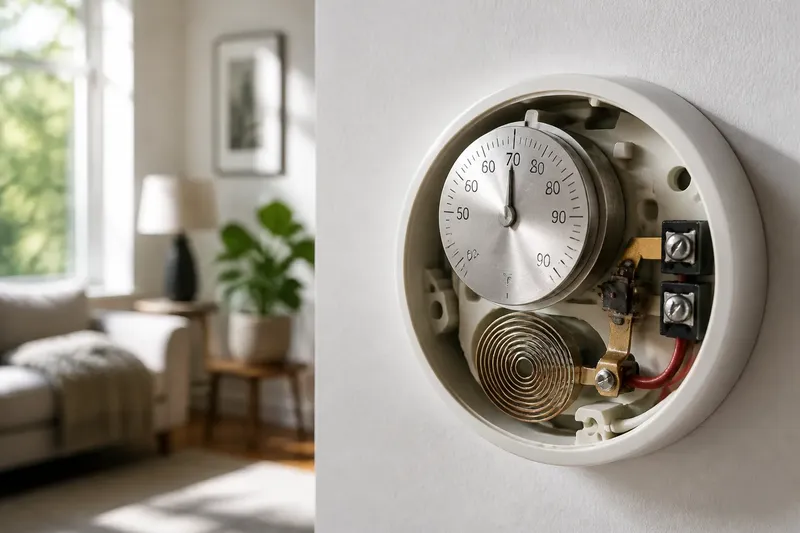
A room thermostat turns the air around its sensor into a signal that can start or stop heat. Before smart-home controls, that signal was often produced by a direct physical change: a temperature-responsive part moved, and its movement operated a switch.
How does a thermostat sense temperature?
A thermostat senses temperature where its sensing element sits, not throughout a house. Sunlight, a draft, a nearby appliance, or a cool exterior wall can affect that local reading.
That distinction is central to understanding the device. A thermostat does not know whether a bedroom feels comfortable or why a hallway is cold; it receives a temperature-related signal and applies its control rules to that signal.
How did mechanical thermostats turn heat into movement?
One familiar mechanical sensing method uses a bimetal strip: two bonded metals respond differently as they warm or cool, causing the strip to bend. In a thermostat, that movement can open or close electrical contacts and call for heat or stop the call.
Other designs used temperature-sensitive fluids or gases. As their volume changed with temperature, they could move a diaphragm or bellows that operated a control. These mechanisms differ in construction, but each translates a physical response to temperature into movement.
These examples describe sensing principles, not a complete historical timeline. Without a specific device, date, or documented setting, it is more accurate to explain how the mechanisms work than to claim which one came first or how quickly room thermostats became common.
How does a thermostat’s signal control heating?
A mechanical thermostat can turn a continuous change in temperature into a simple control state: heat is requested, or it is not. When the sensor indicates that the room is below the control threshold, the contacts can call for heat; after the temperature rises, they can interrupt that call.
This creates a feedback loop. Heating changes the room, the thermostat senses the result, and the next signal depends on that new reading. A small switching range can keep the contacts from changing state every time the reading wavers near one threshold.
There can be a delay between the signal and the room’s response. A warm radiator or furnace may continue releasing heat after the thermostat stops calling, while heat from a distant part of the system may take time to reach the sensor.
What changed when thermostats became electronic?
Electronic thermostats use a temperature-sensitive component and circuitry to interpret its signal. A thermistor, for example, changes electrical resistance as its temperature changes; the circuit can use that change to decide when to call for heat.
Electronics can also support displays, schedules, filtering, and other control rules. The number on the screen, the selected setting, and the moment the heating system starts may not be identical, because a device may process the sensor signal before acting.
Smart features can add remote commands or information from other devices, but they do not make a temperature sensor represent every room automatically. The reading still comes from a particular location, unless the system uses additional sensors and incorporates their signals.
What can a thermostat tell you about a room?
It can report or act on temperature near its sensor. Temperature alone does not identify an open window, explain discomfort, or show conditions in a room separated by a closed door.
Imagine a thermostat on an interior wall that gets direct afternoon sun. Its sensor warms while a shaded corner stays cool, so the heating call may stop before that corner feels warm. Moving the sensor away from direct sunlight could give the control a more representative reading of the space, though the appropriate location depends on the room and heating system.
Which room thermostat questions help explain its signal?
Why does the thermostat reading differ from another thermometer?
The two devices may be in different air conditions or respond differently to sunlight, drafts, or nearby equipment. Place them together in a shaded spot and follow the manufacturer’s instructions; if a concerning difference remains, consult the manufacturer or a qualified technician.
Why does heat continue after the thermostat stops calling?
Warm surfaces or air can keep releasing heat after the signal changes, so the room may continue warming briefly. A thermostat may also use a switching range or delay rather than reacting at one exact displayed value.
Can one thermostat represent every room?
It controls based on its own sensing location, while sunlight, airflow, doors, and building features can make other rooms feel different. If uneven conditions persist, check whether the system supports additional room sensors or ask a qualified heating professional to assess it.
Does a smart thermostat sense temperature differently?
It may use an electronic sensor and software, but the temperature signal still describes conditions at a particular sensing location. Network features change how the signal can be used; they do not make that local reading a complete map of the home.
How should you interpret a thermostat reading?
Use the displayed temperature as a local signal, not a verdict on every room. If comfort varies, check for direct sun, drafts, nearby heat sources, and doors that separate the thermostat from the area you care about.
- Check whether direct sunlight reaches the thermostat; if it does, compare conditions in a shaded location and consider an appropriate sensor location, or ask a qualified professional if relocation involves wiring or system changes.
- Check for a draft from a door, window, or vent; if one reaches the sensor, note whether readings change when the draft is absent, or seek help if the source cannot be addressed safely.
- Check whether a nearby lamp, appliance, or heat source warms the device; if it does, keep that influence in mind when interpreting its signal, or consult the manufacturer about suitable placement.
- Check whether a closed door separates the thermostat from the room that feels uncomfortable; if it does, treat the thermostat reading as local, or see whether the heating system supports an additional room sensor.
- Check the thermostat instructions for sensor and heating-system compatibility; if the listed system matches yours, use the specified control setup, or ask a qualified heating professional before connecting an uncertain system.
- Check whether the display changes while the room remains warm after a heat call ends; if warmth continues briefly, allow for residual heat, or contact a qualified technician if the system keeps running unexpectedly.
The thermostat’s basic job has stayed clear even as its controls have changed: sense temperature at a location, turn that signal into a decision, and pass the decision to compatible heating equipment. When comparing devices, check the sensing location, system compatibility, and any instructions for added sensors; those details explain what the thermostat can act on and what it cannot know.